
Chapter 77
6.5 Decision trees parameter tuning
6.5 Decision trees parameter tuning
Notes
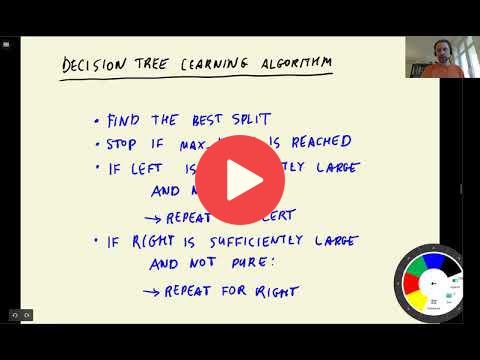
In this lesson, we will discuss about different parameters used to control a Decision Tree (DT). Two of them, max_depth and min_samples_leaf have a greater importance than the others. We will further see how we first tune max_depth parameter and then move to tuning other parameters will help. After that, a dataframe will be created with all possible combinations of max_depth, min_sample_leaf and the auc score corresponding to them. These results will be visualized using a heatmap by pivoting the dataframe to easily determine the best possible max_depth and min_samples_leaf combination. Finally, the DT will be retrained using the identified parameter combination. The DT so trained will be viewed as a tree diagram, for visualizing decision rules.
Steps
-
Fine-Tuning Process: iterate to find optimal parameter settings.
- Start by tuning
max_depthwith various values to determine a subset of optimal depths. - Then, using this subset, fine-tune the model further by exploring different
min_samples_leafvalues.
This method is computationally efficient for large datasets, though it may not be optimal for smaller ones.
- Start by tuning
-
Heatmaps for Visualization: Store the scores (e.g., AUC) obtained during tuning in a pivot table, and create a heatmap with
seabornto easily identify high score areas, which helps pinpoint the optimalmax_depthandmin_samples_leafcombination.
NB: Choose parameter values that effectively control the tree's size and avoid values like 'nan' (Not a Number), even if they seem to lead to better scores.
Importance of max_depth and min_samples_leaf
-
Controlling Overfitting: these parameters play a critical role in preventing overfitting.
max_depthlimits the tree's complexity, preventing it from growing too deep and memorizing the training data.min_samples_leafensures that leaf nodes have a sufficient number of samples, reducing the chance of creating nodes that are too specific to the training data.
-
Impact on Bias and Variance: They also affect the model's bias and variance.
- Increasing
max_depthand decreasingmin_samples_leafcan lead to a more complex model with lower bias but higher variance. - Decreasing
max_depthand increasingmin_samples_leafresults in a simpler model with higher bias but lower variance.
- Increasing
It's then important to find the right balance between max_depth and min_samples_leaf to achieve optimal model performance.
This involves a trade-off between bias and variance, and the best values depend on the specific dataset and problem.
Add notes from the video (PRs are welcome)