
Chapter 86
Transformers for Vision
%load_ext d2lbook.tab
tab.interact_select(['pytorch', 'jax'])Transformers for Vision
The Transformer architecture was initially proposed
for sequence-to-sequence learning,
with a focus on machine translation.
Subsequently, Transformers emerged as the model of choice
in various natural language processing tasks Radford.Narasimhan.Salimans.ea.2018,Radford.Wu.Child.ea.2019,brown2020language,Devlin.Chang.Lee.ea.2018,raffel2020exploring.
However, in the field of computer vision
the dominant architecture has remained
the CNN (chap_modern_cnn).
Naturally, researchers started to wonder
if it might be possible to do better
by adapting Transformer models to image data.
This question sparked immense interest
in the computer vision community.
Recently, :citet:ramachandran2019stand proposed
a scheme for replacing convolution with self-attention.
However, its use of specialized patterns in attention
makes it hard to scale up models on hardware accelerators.
Then, :citet:cordonnier2020relationship theoretically proved
that self-attention can learn to behave similarly to convolution.
Empirically, patches were taken from images as inputs,
but the small patch size makes the model
only applicable to image data with low resolutions.
Without specific constraints on patch size, vision Transformers (ViTs) extract patches from images and feed them into a Transformer encoder to obtain a global representation, which will finally be transformed for classification Dosovitskiy.Beyer.Kolesnikov.ea.2021. Notably, Transformers show better scalability than CNNs: and when training larger models on larger datasets, vision Transformers outperform ResNets by a significant margin. Similar to the landscape of network architecture design in natural language processing, Transformers have also become a game-changer in computer vision.
%%tab pytorch
from d2l import torch as d2l
import torch
from torch import nn%%tab jax
from d2l import jax as d2l
from flax import linen as nn
import jax
from jax import numpy as jnpModel
fig_vit depicts the model architecture of vision Transformers. This architecture consists of a stem that patchifies images, a body based on the multilayer Transformer encoder, and a head that transforms the global representation into the output label.
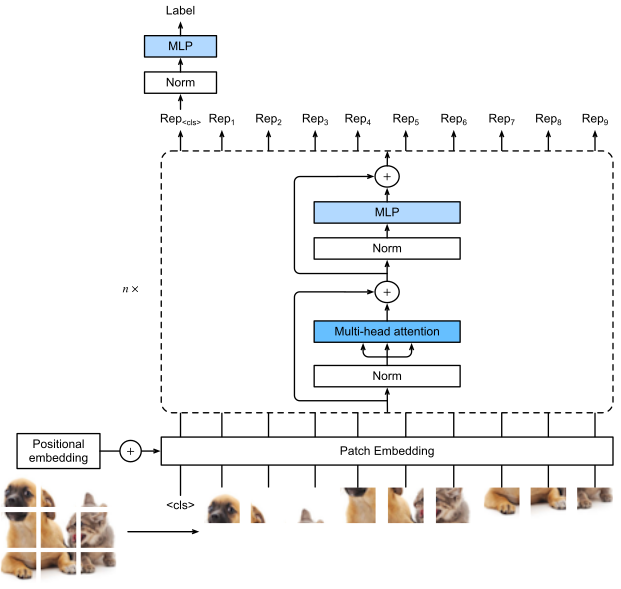
Consider an input image with height , width , and channels. Specifying the patch height and width both as , the image is split into a sequence of patches, where each patch is flattened to a vector of length . In this way, image patches can be treated similarly to tokens in text sequences by Transformer encoders. A special “<cls>” (class) token and the flattened image patches are linearly projected into a sequence of vectors, summed with learnable positional embeddings. The multilayer Transformer encoder transforms input vectors into the same number of output vector representations of the same length. It works exactly the same way as the original Transformer encoder in fig_transformer, only differing in the position of normalization. Since the “<cls>” token attends to all the image patches via self-attention (see fig_cnn-rnn-self-attention), its representation from the Transformer encoder output will be further transformed into the output label.
Patch Embedding
To implement a vision Transformer, let's start with patch embedding in fig_vit. Splitting an image into patches and linearly projecting these flattened patches can be simplified as a single convolution operation, where both the kernel size and the stride size are set to the patch size.
%%tab pytorch
class PatchEmbedding(nn.Module):
    def __init__(self, img_size=96, patch_size=16, num_hiddens=512):
        super().__init__()
        def _make_tuple(x):
            if not isinstance(x, (list, tuple)):
                return (x, x)
            return x
        img_size, patch_size = _make_tuple(img_size), _make_tuple(patch_size)
        self.num_patches = (img_size[0] // patch_size[0]) * (
            img_size[1] // patch_size[1])
        self.conv = nn.LazyConv2d(num_hiddens, kernel_size=patch_size,
                                  stride=patch_size)

    def forward(self, X):
        # Output shape: (batch size, no. of patches, no. of channels)
return self.conv(X).flatten(2).transpose(1, 2)%%tab jax
class PatchEmbedding(nn.Module):
img_size: int = 96
patch_size: int = 16
num_hiddens: int = 512
def setup(self):
def _make_tuple(x):
if not isinstance(x, (list, tuple)):
return (x, x)
return x
img_size, patch_size = _make_tuple(self.img_size), _make_tuple(self.patch_size)
self.num_patches = (img_size[0] // patch_size[0]) * (
img_size[1] // patch_size[1])
self.conv = nn.Conv(self.num_hiddens, kernel_size=patch_size,
strides=patch_size, padding='SAME')
def __call__(self, X):
# Output shape: (batch size, no. of patches, no. of channels)
X = self.conv(X)
return X.reshape((X.shape[0], -1, X.shape[3]))In the following example, taking images with height and width of img_size as inputs,
the patch embedding outputs (img_size//patch_size)**2 patches
that are linearly projected to vectors of length num_hiddens.
%%tab pytorch
img_size, patch_size, num_hiddens, batch_size = 96, 16, 512, 4
patch_emb = PatchEmbedding(img_size, patch_size, num_hiddens)
X = d2l.zeros(batch_size, 3, img_size, img_size)
d2l.check_shape(patch_emb(X),
(batch_size, (img_size//patch_size)**2, num_hiddens))%%tab jax
img_size, patch_size, num_hiddens, batch_size = 96, 16, 512, 4
patch_emb = PatchEmbedding(img_size, patch_size, num_hiddens)
X = d2l.zeros((batch_size, img_size, img_size, 3))
output, _ = patch_emb.init_with_output(d2l.get_key(), X)
d2l.check_shape(output, (batch_size, (img_size//patch_size)**2, num_hiddens))Vision Transformer Encoder
The MLP of the vision Transformer encoder is slightly different from the positionwise FFN of the original Transformer encoder (see subsec_positionwise-ffn). First, here the activation function uses the Gaussian error linear unit (GELU), which can be considered as a smoother version of the ReLU Hendrycks.Gimpel.2016. Second, dropout is applied to the output of each fully connected layer in the MLP for regularization.
%%tab pytorch
class ViTMLP(nn.Module):
    def __init__(self, mlp_num_hiddens, mlp_num_outputs, dropout=0.5):
        super().__init__()
        self.dense1 = nn.LazyLinear(mlp_num_hiddens)
        self.gelu = nn.GELU()
        self.dropout1 = nn.Dropout(dropout)
        self.dense2 = nn.LazyLinear(mlp_num_outputs)
        self.dropout2 = nn.Dropout(dropout)

    def forward(self, x):
        return self.dropout2(self.dense2(self.dropout1(self.gelu(
self.dense1(x)))))%%tab jax
class ViTMLP(nn.Module):
mlp_num_hiddens: int
mlp_num_outputs: int
dropout: float = 0.5
@nn.compact
def __call__(self, x, training=False):
x = nn.Dense(self.mlp_num_hiddens)(x)
x = nn.gelu(x)
x = nn.Dropout(self.dropout, deterministic=not training)(x)
x = nn.Dense(self.mlp_num_outputs)(x)
x = nn.Dropout(self.dropout, deterministic=not training)(x)
return xThe vision Transformer encoder block implementation just follows the pre-normalization design in fig_vit, where normalization is applied right before multi-head attention or the MLP. In contrast to post-normalization ("add & norm" in fig_transformer), where normalization is placed right after residual connections, pre-normalization leads to more effective or efficient training for Transformers baevski2018adaptive,wang2019learning,xiong2020layer.
%%tab pytorch
class ViTBlock(nn.Module):
    def __init__(self, num_hiddens, norm_shape, mlp_num_hiddens,
                 num_heads, dropout, use_bias=False):
        super().__init__()
        self.ln1 = nn.LayerNorm(norm_shape)
        self.attention = d2l.MultiHeadAttention(num_hiddens, num_heads,
                                                dropout, use_bias)
        self.ln2 = nn.LayerNorm(norm_shape)
        self.mlp = ViTMLP(mlp_num_hiddens, num_hiddens, dropout)

    def forward(self, X, valid_lens=None):
        X = X + self.attention(*([self.ln1(X)] * 3), valid_lens)
return X + self.mlp(self.ln2(X))%%tab jax
class ViTBlock(nn.Module):
num_hiddens: int
mlp_num_hiddens: int
num_heads: int
dropout: float
use_bias: bool = False
def setup(self):
self.attention = d2l.MultiHeadAttention(self.num_hiddens, self.num_heads,
self.dropout, self.use_bias)
self.mlp = ViTMLP(self.mlp_num_hiddens, self.num_hiddens, self.dropout)
@nn.compact
def __call__(self, X, valid_lens=None, training=False):
X = X + self.attention(*([nn.LayerNorm()(X)] * 3),
valid_lens, training=training)[0]
return X + self.mlp(nn.LayerNorm()(X), training=training)Just as in subsec_transformer-encoder, no vision Transformer encoder block changes its input shape.
%%tab pytorch
X = d2l.ones((2, 100, 24))
encoder_blk = ViTBlock(24, 24, 48, 8, 0.5)
encoder_blk.eval()
d2l.check_shape(encoder_blk(X), X.shape)%%tab jax
X = d2l.ones((2, 100, 24))
encoder_blk = ViTBlock(24, 48, 8, 0.5)
d2l.check_shape(encoder_blk.init_with_output(d2l.get_key(), X)[0], X.shape)Putting It All Together
The forward pass of vision Transformers below is straightforward.
First, input images are fed into an PatchEmbedding instance,
whose output is concatenated with the “<cls>” token embedding.
They are summed with learnable positional embeddings before dropout.
Then the output is fed into the Transformer encoder that stacks num_blks instances of the ViTBlock class.
Finally, the representation of the “<cls>” token is projected by the network head.
%%tab pytorch
class ViT(d2l.Classifier):
    """Vision Transformer."""
    def __init__(self, img_size, patch_size, num_hiddens, mlp_num_hiddens,
                 num_heads, num_blks, emb_dropout, blk_dropout, lr=0.1,
                 use_bias=False, num_classes=10):
        super().__init__()
        self.save_hyperparameters()
        self.patch_embedding = PatchEmbedding(
            img_size, patch_size, num_hiddens)
        self.cls_token = nn.Parameter(d2l.zeros(1, 1, num_hiddens))
        num_steps = self.patch_embedding.num_patches + 1  # Add the cls token
        # Positional embeddings are learnable
        self.pos_embedding = nn.Parameter(
            torch.randn(1, num_steps, num_hiddens))
        self.dropout = nn.Dropout(emb_dropout)
        self.blks = nn.Sequential()
        for i in range(num_blks):
            self.blks.add_module(f"{i}", ViTBlock(
                num_hiddens, num_hiddens, mlp_num_hiddens,
                num_heads, blk_dropout, use_bias))
        self.head = nn.Sequential(nn.LayerNorm(num_hiddens),
                                  nn.Linear(num_hiddens, num_classes))

    def forward(self, X):
        X = self.patch_embedding(X)
        X = d2l.concat((self.cls_token.expand(X.shape[0], -1, -1), X), 1)
        X = self.dropout(X + self.pos_embedding)
        for blk in self.blks:
            X = blk(X)
return self.head(X[:, 0])%%tab jax
class ViT(d2l.Classifier):
"""Vision Transformer."""
img_size: int
patch_size: int
num_hiddens: int
mlp_num_hiddens: int
num_heads: int
num_blks: int
emb_dropout: float
blk_dropout: float
lr: float = 0.1
use_bias: bool = False
num_classes: int = 10
training: bool = False
def setup(self):
self.patch_embedding = PatchEmbedding(self.img_size, self.patch_size,
self.num_hiddens)
self.cls_token = self.param('cls_token', nn.initializers.zeros,
(1, 1, self.num_hiddens))
num_steps = self.patch_embedding.num_patches + 1 # Add the cls token
# Positional embeddings are learnable
self.pos_embedding = self.param('pos_embed', nn.initializers.normal(),
(1, num_steps, self.num_hiddens))
self.blks = [ViTBlock(self.num_hiddens, self.mlp_num_hiddens,
self.num_heads, self.blk_dropout, self.use_bias)
for _ in range(self.num_blks)]
self.head = nn.Sequential([nn.LayerNorm(), nn.Dense(self.num_classes)])
@nn.compact
def __call__(self, X):
X = self.patch_embedding(X)
X = d2l.concat((jnp.tile(self.cls_token, (X.shape[0], 1, 1)), X), 1)
X = nn.Dropout(emb_dropout, deterministic=not self.training)(X + self.pos_embedding)
for blk in self.blks:
X = blk(X, training=self.training)
return self.head(X[:, 0])Training
Training a vision Transformer on the Fashion-MNIST dataset is just like how CNNs were trained in chap_modern_cnn.
%%tab all
img_size, patch_size = 96, 16
num_hiddens, mlp_num_hiddens, num_heads, num_blks = 512, 2048, 8, 2
emb_dropout, blk_dropout, lr = 0.1, 0.1, 0.1
model = ViT(img_size, patch_size, num_hiddens, mlp_num_hiddens, num_heads,
            num_blks, emb_dropout, blk_dropout, lr)
trainer = d2l.Trainer(max_epochs=10, num_gpus=1)
data = d2l.FashionMNIST(batch_size=128, resize=(img_size, img_size))
trainer.fit(model, data)
Summary and Discussion
You may have noticed that for small datasets like Fashion-MNIST, our implemented vision Transformer does not outperform the ResNet in sec_resnet. Similar observations can be made even on the ImageNet dataset (1.2 million images). This is because Transformers lack those useful principles in convolution, such as translation invariance and locality (sec_why-conv). However, the picture changes when training larger models on larger datasets (e.g., 300 million images), where vision Transformers outperform ResNets by a large margin in image classification, demonstrating intrinsic superiority of Transformers in scalability Dosovitskiy.Beyer.Kolesnikov.ea.2021. The introduction of vision Transformers has changed the landscape of network design for modeling image data. They were soon shown to be effective on the ImageNet dataset with data-efficient training strategies of DeiT touvron2021training. However, the quadratic complexity of self-attention (sec_self-attention-and-positional-encoding) makes the Transformer architecture less suitable for higher-resolution images. Towards a general-purpose backbone network in computer vision, Swin Transformers addressed the quadratic computational complexity with respect to image size (subsec_cnn-rnn-self-attention) and reinstated convolution-like priors, extending the applicability of Transformers to a range of computer vision tasks beyond image classification with state-of-the-art results liu2021swin.
Exercises
- How does the value of
img_sizeaffect training time? - Instead of projecting the “<cls>” token representation to the output, how would you project the averaged patch representations? Implement this change and see how it affects the accuracy.
- Can you modify hyperparameters to improve the accuracy of the vision Transformer?
pytorch
jax